Restaurant owners and managers deal with a constant stream of decisions throughout the day. Staffing changes, deliveries, customer flow, and closing procedures all require attention, and most of those tasks happen quickly. Security systems are often installed at some point during that process and then left to operate quietly in the background. As long as the cameras appear to be recording and the alarm arms at night, the system rarely becomes part of the daily conversation.
The moment something unexpected happens, however, the expectations change. A missing inventory item, a customer dispute, a late-night break-in, or a question about employee activity can shift the focus immediately. At that point the security system stops being a background tool and becomes the primary source of information for understanding what actually occurred inside the restaurant.
Restaurants across San Bernardino and the Inland Empire frequently turn to ATI after situations like these raise questions about how well their systems support incident review and documentation. What tends to surface during those conversations is not necessarily a complete system failure, but a lack of clarity. Cameras may exist, yet they are not positioned where the most useful activity takes place. Access to certain doors may not be documented clearly. Footage may exist but be difficult to locate or export when it is needed quickly. When the system cannot easily provide answers, even small incidents become harder to resolve.
Why Restaurant Environments Require a Different Security Approach
Restaurants present a unique environment for security planning because the operation moves so quickly and involves multiple types of activity in the same space. Staff move between kitchen areas, storage rooms, and service counters throughout the day. Deliveries arrive through side or rear entrances. Managers handle cash procedures at the beginning and end of shifts. Late-night closing routines may involve only a few employees inside the building. Each of these moments creates a point where visibility and accountability matter.
Video surveillance remains one of the most valuable tools in that environment, but effective coverage requires more than placing cameras in the corners of the dining room. The most useful camera views often focus on areas where activity is concentrated rather than where equipment is easiest to install. Entry points, preparation areas, storage rooms, and exterior doors typically provide the clearest understanding of how the building is being used. When those areas are covered properly, management can review events without guessing about what occurred outside the frame.
Managing Staff Access and Daily Activity
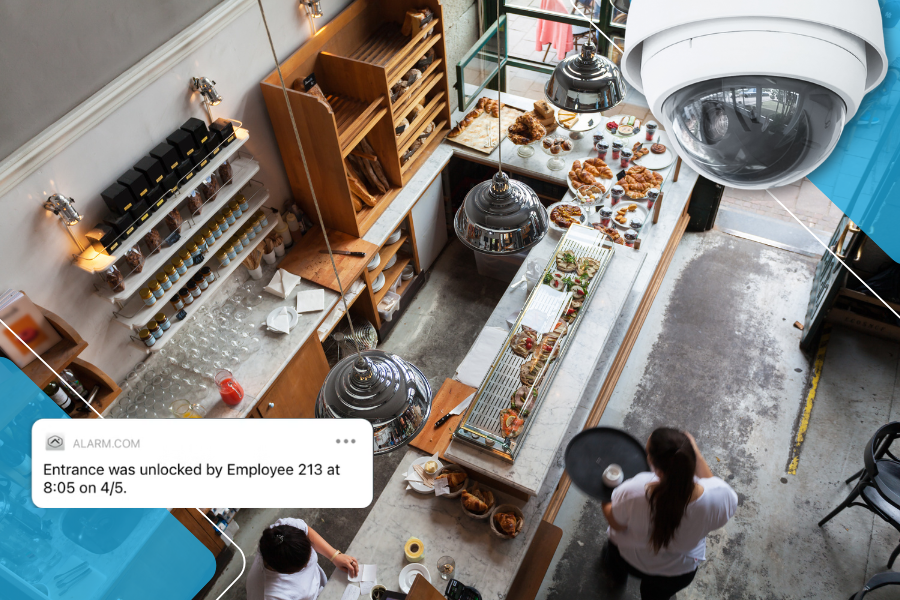
Access control can also play an important role in restaurants where multiple staff members enter the building at different times of day. Traditional keys make it difficult to track who entered and when, especially in businesses with frequent staff turnover. Systems that use unique credentials or codes create a clear record of entry activity while allowing managers to update permissions quickly when staffing changes. That level of visibility helps prevent situations where former employees or temporary staff retain access longer than intended.
Alarm systems remain the backbone of overnight protection, particularly for restaurants that store valuable equipment or inventory. When an alarm activates, the goal is not simply to trigger a notification but to ensure the event is communicated clearly to monitoring operators and management. Reliable communication pathways, proper programming, and routine system checks help ensure that alarms function consistently during the hours when the building is unoccupied.
Improving an Existing System Without Replacing Everything
Many restaurant owners assume that upgrading security requires replacing everything they already have. In reality, many systems can be improved through adjustments rather than full replacement. Cameras may only need to be repositioned or supplemented in a few areas. Access permissions may need to be updated so they reflect current staff roles. Recording retention settings can be adjusted so footage remains available long enough to support incident reviews or insurance questions.
These types of adjustments often become apparent during a structured review of the existing system. A walkthrough of the building allows technicians to see how the restaurant actually operates during normal business hours and how security equipment supports or fails to support those activities. From there, practical improvements can be identified without disrupting the day-to-day rhythm of the operation.
The Value of Local Support for Restaurants
For restaurants in the Inland Empire, local service also matters. Restaurants operate on tight schedules, and when equipment needs attention, delays can create unnecessary disruption. Working with a provider based in San Bernardino allows adjustments, service visits, and system updates to happen more efficiently when the restaurant’s schedule allows for it.
A Security System That Provides Clear Answers
Security in a restaurant environment ultimately serves one purpose: providing clarity when questions arise. Managers should be able to review footage quickly, confirm entry activity, and understand what happened without relying on assumptions. When a system supports that process, it becomes a practical management tool rather than a piece of equipment that is only noticed when something goes wrong.
ATI works with restaurants throughout San Bernardino and the Inland Empire to review existing systems, improve visibility, and ensure security technology aligns with how each restaurant actually operates. The goal is not to add equipment unnecessarily, but to ensure the system can provide reliable answers when it matters most.
If you would like to review how your restaurant’s security system would perform during an incident, call 951-374-1551 or contact ATI to schedule a consultation.